|
|
||
|
Um
den Verkauf der Goliath-Fahrzeuge weiter anzukurbeln, griff man
bei Goliath auf ein altbewährtes “Rezept” zurück:
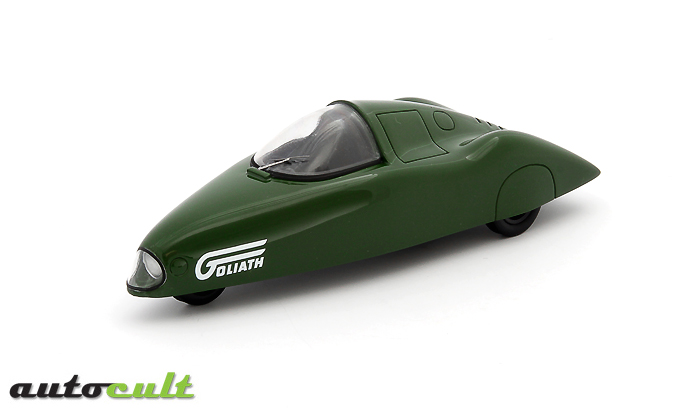
Ein Wagen musste entstehen, der Rekorde einfuhr. Insgesamt
stellte der Goliath-Rekordwagen 38 Weltrekorde in den neu geschaffenen
Klassen für Dreiradfahrzeuge bis 750ccm und bis 1200ccm Hubraum
auf. Die bedeutendsten Rekorde waren die zwei Stunden mit einem
Durchschnitt von 155km/h und die 2000-Meilen mit 130km/h. Als
Fahrer wechselten sich Hugo Steiner, Adolf Brudes, Hans Hugo Hartmann,
Otto Koch-Bodes und Helmut Polensky ab. Bei einer Wiederholung solcher Rekordfahrten auf dem deutschen Hockenheimring im Herbst 1951, überschlug sich der Wagen und wurde völlig zerstört. Der Fahrer Hugo Steiner verletzte sich dabei tödlich.
Is it a Car? Is it a Motorcycle? To boost sales of the Goliath-vehicles, a well-used but still valuable recipe was used…. A vehicle should be created to break all the records. In
1951, the idea of the Goliath began, but the project did not start
with immediate construction or concept designs. It began with
the study of automotive record lists. The best chances were seen
in the category of “vehicles up to 750cc engines”. With
the combination of this design and power, the Goliath could reach
a top speed of 155 km/h. This speed allowed the Goliath to set
38 world records in total in the newly created classes for three-wheelers
that had 750cc – 1200cc engines. However,
after all this work, the FIA did not recognized the records officially.
They said it was because they were not certain of the vehicle
type. This accident also tragically claimed the life of the driver, Hugo Steiner. |
||
 |
||
 |
Ecco il rimedio per incrementare le vendite dei veicoli Goliath…. Creare una macchina che batteva tutti i record. Nel 1951 Goliath iniziò a riflettere su questa idea, ma il progetto non prese vita con la costruzione ed il desing del concept, bensì con lo studio delle liste delle auto da record. Le migliori facevano parte della categoria “ Veicoli con motori fino a 750cc”. Goliath usava motori da 700cc, ma grazie ad una maggiorata compressione e al carburatore più grande, la potenza dei cavalli si elevava da 24 a 42. Gli assi, le ruote e la scatola del cambio erano parti di un furgoncino a 3 ruote. L’unico componente speciale costruito era lo chassis in metallo leggero. Grazie
alla combinazione del design e della potenza, la Goliath poteva
raggiungere la velocità massima di 155 km/h. Stabilì
così 38 record mondiali, nella categoria 3 ruote, motore
750cc – 1200cc. Sfortunatamente la FIA non riconobbe mai ufficialmente questi record e questo perché non era sicura del tipo di veicolo. Si cercò allora un’alternativa e, ad uno dei membri della squadra, venne la brillante idea di classificare il mezzo nella categoria delle motociclette. La FIA non poté rifiutare questa proposta ed il veicolo venne riconosciuto, concedendo ai piloti la licenza di guida della moto per poter prendere parte ai concorsi. Nell’autunno
del 1951 venne raggiungo nuovamente il record durante la gara
di Hockenheimring, ma la macchina si capovolse e si distrusse
e l’incidente costò la vita al pilota Hugo Steiner. |
|



 Goliath Rekordwagen ( 1951 )
 Goliath record car ( 1951 )
 Goliath Rekordwagen ( 1951 )